The Strategic Arms Limitation Talks (SALT) are a series of bilateral agreements between the USSR and the USA on the issue of nuclear security. There were several rounds of negotiations. As a result, the OSV-1 and OSV-2 agreements were signed. The first - in 1972, the second - in 1979.
Background and the concept of "sufficiency" in the USSR
If we talk about the prerequisites and the reasons why the first signing of the OSV-1 treaty occurred, then here we need to mention the concept of "sufficiency" in nuclear weapons. This term was ambiguously perceived in the West, but this fact did not affect the behavior of the Soviet side at all. At the XXVI Congress of the CPSU, our official nuclear concept was announced. Its essence is that the USSR and the USA have a balance that objectively serves to preserve peace, and there are a sufficient number of nuclear warheads in service that are distributed evenly between the Strategic Missile Forces, the Navy and the Air Force. We do not need any quantitative superiority over the Americans. In fact, the leadership of the USSR announced that there would no longer be any arms race. N. Khrushchev at one time declared to Kennedy that it does not matter for our country how many times the United States can destroy it - eight or nine. It is enough for us to know that the USSR can destroy the United States at least once. In fact, this is the whole essence of the "concept of sufficiency", which was officially formalized at the party congress.
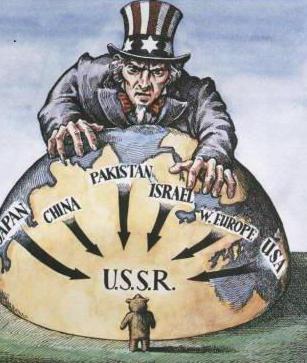
US Position
The United States took this differently: they were reluctant to sign the SALT-1 treaty. The reason lies in the internal political struggle: in the United States two parties compete in elections. One must always criticize the other. In the sixties of the last century, the Democratic Party was in solidarity with the Soviet side and made the Republican Nixon begin his reign with the issue of limiting arms. This was a serious puzzle for the new president, since throughout the entire election campaign he criticized the possible nuclear parity of the USSR and the USA. All the time he declared that it was necessary to achieve total superiority in armaments over our country. This is what the loser Democrats took advantage of, putting a “pig” under the chair of the new president.
Nixon fell into a stalemate: on the one hand, he criticized the idea of parity between the USSR and the USA, and was a supporter of nuclear quantitative superiority. And on the other hand, the buildup of the arms race unilaterally - with the official announcement of the USSR on the limitation of the number of its nuclear weapons - undermined the image of the United States as a "force of good" that is fighting the "Empire of Evil." It turns out that the parties are changing roles in the eyes of the entire Western capitalist world. In this regard, Nixon had to make concessions and agree to sign the OSV-1 agreement.
USA concept under Nixon
To state that the USA and the USSR are signing new treaties, and parity is being established, naturally, the president from the Republican Party could not. That is why the “sufficiency strategy” was also chosen in the USA. Those. for voters, it was something between the concept of total superiority and the concept of nuclear parity. In fact, this point of view is not at all populist: the United States did possess a larger stock of nuclear weapons than the USSR.
The replica of Deputy Minister of Defense D. Packard is indicative: “Sufficiency only means that this word is convenient to use in speeches. Other than that, it means nothing. ” Most likely, President Nixon regarded the “concept of sufficiency” as a compromise between his election program and the policies of the Democrats prior to him.
Principles for the development of American strategic forces
So, the Nixon administration has announced the "concept of sufficiency." The following principles have been formally proposed:
- Maintaining a sufficient number of strategic weapons to retaliate even after a “sudden nuclear attack”.
- Elimination of any incentive for a "surprise attack."
- Depriving an alleged adversary of the opportunity to damage the United States more than the United States can do in a retaliatory strike.
- Ensuring US protection against nuclear strikes.
As always happens in American diplomacy, this project can be “tailored”, both for the “concept of sufficiency” and for the doctrine of “total superiority”, since there are no clear plans and specific figures in it. Many military experts said that either side can consider this concept as it pleases, and will be right. However, a direct rejection of total superiority is already a certain progress in US policy, without which the signing of the SALT-1 treaty becomes absolutely impossible.
Missile defense problem
The whole point of American politics was revealed in the discussion of missile defense systems. The fact is that the USSR has gone ahead in missile defense technology. We learned 23 years earlier than Americans to shoot down nuclear missiles with non-nuclear missiles due to the kinetic energy from a TNT equivalent explosion . In fact, we had a safe shield that allowed us not to explode nuclear warheads on our territory. The Americans could only shoot down nuclear missiles with other nuclear missiles with less power. In any case, to avoid a nuclear explosion in the United States failed. Therefore, the Americans insisted on refusing to create a missile defense system when discussing OSV-1 and OSV-2.
The United States attributed the rejection of the development of missile defense to the fact that supposedly there is no point in limiting the offensive arms race, if the defensive race is not prohibited. According to the Americans, the continued development of missile defense by the Soviet side destabilizes the established delicate balance between the two superpowers. In this matter, the United States seemed to have forgotten about its superiority in offensive weapons and about Nixon's election promises.
The Soviet side categorically opposed such an approach, rightly declaring that the development of defense is moral, and the development of an attack is immoral. In addition, the Americans were asked to solve the problem of reducing offensive weapons, also rightly stating that the United States had an advantage over them.
Deployment of US missile defense - threat of upcoming agreements
In 1967, the US Administration unilaterally deployed its missile defense system. They explained this by the fact that the system was not directed against the USSR, but had as its goal to neutralize the threat to the PRC. The latter had by that time only nominal nuclear weapons, which could not threaten the United States. Surprisingly, the story is repeated with the US missile defense in Eastern Europe, which is supposedly directed against Iran, although it does not threaten either the United States or Eastern European countries. Military experts noted then, as they now note, that the goal of the Americans is our country.
By 1972, the US Government and Department of Defense could no longer justify themselves before the anti-militarist forces in the Western world. The US nuclear stockpile was increasing, weapons were being improved, and no prerequisites for this were observed. Our country, in spite of the Americans, pursued a friendly policy, agreeing to any agreements - shortly before that, an agreement had been signed to limit the development of the missile defense system.
Nixon's visit to the USSR and the signing of treaties
In May 1972, Nixon made a historic visit to Moscow. A preliminary strategic arms limitation treaty was signed on May 29, 1972. It was called "The basis of interaction between the USSR and the USA." Both sides recognized that the peaceful coexistence of both great powers is the only acceptable basis for mutual relations. Both countries also took responsibility to prevent local conflicts, took the responsibility to exercise restraint and resolve disagreements by peaceful means.
In May, another treaty was signed - the "Treaty on the Limitation of Missile Defense Systems". The parties had to select certain areas on their territory on which missile defense facilities would be located. The USSR protected Moscow from nuclear attacks. USA - several nuclear weapons facilities.
Signing of the OSV-1 agreement: date, main provisions
OSV-1 is a set of agreements between America and the USSR from 1969 to 1972. It all started in Helsinki. And many believed that he would remain in the project. However, the signing of the Soviet-American treaty OSV-1 by Nixon in Moscow in 1972 took place. The nuclear weapons of the USSR and the USA have since been strictly fixed. An increase in the number of warheads was prohibited. A moratorium was also introduced on the test of nuclear weapons in the USSR, but this did not mean that our country was ready to refuse to continue work on the development of nuclear energy weapons.
At this time, the Soviet Union deployed up to 200 new missiles. The United States had 1,054 Intercontinental ballistic missiles, 656 missiles in submarines. The nuclear weapons of the USSR and the United States have remained unchanged since that time. However, the Americans adopted a new type of missile - RGCH (missiles with multiple parts). Their peculiarity is that nominally this is one missile, but it affects several strategic targets.
OSV-2
OSV-1 and OSV-2 is a single system of contracts. The second was a logical continuation of the first. The only difference was that OSV-2 was a single agreement signed on June 18, 1979 in Vienna at the meeting of L. Brezhnev and D. Carter.
Key Points
OSV-2 limited the number of strategic carriers to 2,400 pieces. Both parties also agreed to reduce this volume. Only 1320 units could be equipped with warheads with a given target. This number included all types of nuclear weapons. In addition to this, the restrictions affected the number of warheads that could be deployed on strategic carriers: ships, planes, submarines.
OSV-2 also prohibited the commissioning of new missile mines, limited modernization. Each side, for example, could deploy no more than one new intercontinental ballistic missile, which could be equipped with 10 warheads.
OSV-2 was not ratified in the United States, as the Soviet Union sent troops into Afghanistan. However, both parties complied with the informal contract.
START-1 and START-2
The history of restrictive agreements on OSV-2 has not ended. On July 31, 1991, the Treaty on the Reduction and Limitation of Strategic Offensive Arms of the Soviet Union and the USA (START-1) was signed in Moscow. This is one of the last treaties of the USSR, signed by M. Gorbachev. Its validity period was 15 years. The purpose of the treaty is to reduce weapons to 30 percent of all available nuclear forces. An exception was only made for marine cruise missiles with a range of over 600 km. This is not surprising: the United States had a huge number of such missiles, but our country did not have them at all.
After the collapse of the USSR, it was necessary to re-sign the agreement already with Russia, since there was a risk that our country would not fulfill the START-1 conditions. In January 1993, a new treaty was signed - START II by B. Yeltsin and George W. Bush. In 2002, our country withdrew from the treaty in response to the fact that the United States withdrew from the ABM treaty. In 2009, D. Medvedev and B. Obama were negotiating a new START treaty in Geneva, but the Republican American Congress blocked all the initiatives of Democrat B. Obama in this matter. The official wording of the congressmen is "The United States is afraid of" cheating "on the part of Russia to fulfill the treaty."
START-3
In 2010, the presidents of Russia and the United States signed a new treaty. Each side on it can have no more than 1,550 nuclear warheads. The number of strategic carriers should not exceed more than 800 units. This agreement has been ratified by both parties.